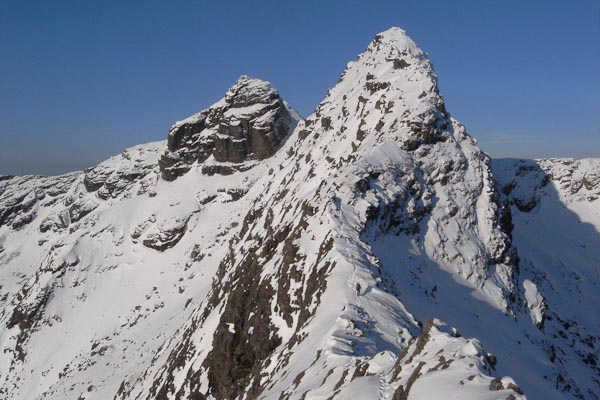
Exploring Stob Ban

Helen Rennard on the first ascent of Shining Edge (III,4) on the East Wing of Stob Ban in the Mamores. The route continues up the vertical turfy groove in the top centre of the photo. (Photo Simon Richardson)

After being battered by wind and blizzards whilst climbing on Ben Nevis last Saturday, Helen Rennard and I were looking for an easier option for Sunday December 4. The forecast was for more snow and strong winds, so after a lot of humming and hawing (on my part at least), we decided to visit Stob Bab in the Mamores.

I had never climbed on Stob Ban before, but I had walked up to look at the cliffs over 20 years ago, and was keen to make a return visit. I knew it wasn’t the ideal choice for Sunday, because the cliffs face north-east and had been sheltered from the prevailing westerlies, and the turf was less likely to be frozen than more exposed aspects. But, I reasoned, Stob Ban is comprised of quartzite, which unlike schist and granite has less inherent nutrients, so the cliff was unlikely to be very turfy, and the climbing would rely on snowed-up rock.

As it turned out, I was completely wrong about the vegetation – the cliff was as turfy as most other Scottish crags, but fortunately we found an exposed crest to the right of the gully-line of Eag Blanc on the East Wing. Our route looked steep and daunting from below, but in the event it was far easier than it looked, and provided an excellent III,4. And even the turf was frozen!

Posted in New Routes | Tagged , , | 3 Comments

All Alone on Aonach Dubh

Looking up Number 3 Gully Rib (II/III) on the West Face of Aonach Dubh. The route follows the snowed up rock on the left side of the picture with the deep Number 3 Gully on the right. Climbing solo, James Roddie made the first winter ascent of this natural winter line on December 5. (Photo James Roddie)

James Roddie has been exploring the crags of Glen Coe for a couple of years now, often as bold solo outings. His latest adventure was on Monday December 5, when he made the first ascent of Number 3 Gully Rib (II/III) on the West Face of Aonach Dubh. James takes up the story:

“Given the westerly winds, I knew that a buttress route on a West face would be likely to give good climbing and frozen turf, so I headed up underneath B Buttress on the West face of Aonach Dubh. It’s a rarely visited area of Glencoe in the winter, void of crampon scratches and still with potential for more new routes. I’d been up a summer route here before a few times but I couldn’t find any record of it as a winter route so I thought it well worthwhile a look.

At the base of The Pinnacle Face you break right at the level of the Middle Ledge onto a rib running up the left hand side of Number 3 Gully. There was plenty of fresh powder around but lots of frozen turf. I took the rib as directly as possible, with a few awkward moves on the steeper sections as the rock type doesn’t give many cracks or great hooks. I climbed a final narrow chimney and topped out to the Upper Rake just as very heavy snow started to fall. The traverse across the top of Number 2 Gully, to escape the face, was quite spicy on soft snow.”

Posted in New Routes | Tagged , | 1 Comment

Defenders of the Faith – Second Ascent

Dave MacLeod on the first ascent of Defenders of the Faith (IX,9) on Creag an Socach in the Southern Highlands in March 2006. This was the first Scottish Grade IX to receive an on sight first ascent. It was repeated today by Greg Boswell and Will Sim. (Archive Photo Dave Brown)

Breaking News – I’ve just received a text from Greg Boswell to say that he has made the second ascent (on sight) of Defenders of the Faith (IX,9) today (December 6) with Will Sim. This route climbs the overhanging right side of Creag an Socach above Bridge of Orchy and was first climbed by Dave MacLeod and Fiona Murray in March 2006. The route was an important landmark in the development of Scottish winter climbing as it was the first time a new Grade IX had been put up on sight.

“Really good conditions up there,” Greg told me, “with some ice around and frozen turf.”

After a late start, this season is now getting into full gear…

Posted in Repeats | Tagged , , | 2 Comments

Busy Weekend on The Ben

Greg Boswell on the first ascent of The Big Cheese (VIII,8) on Moonlight Gully Buttress on Ben Nevis. Boswell climbed this three-pitch icy mixed route with Jim Higgins and Harry Holmes on Sunday December 4. The trio named the route in honour of a massive lump of Cheddar (about the size of a breeze block) that they had carried up to the CIC Hut for their dinner. (Photo Jim Higgins)

When Helen Rennard and I walked up to the CIC Hut early on Saturday morning (December 3), we were expecting to find it empty. Instead, we found it full of the stars of the 2011 Scottish Tooling Series. They had won a long weekend in the hut in the company of Scottish winter gurus Malcolm Bass, Simon Yearsley and Greg Boswell as a prize for winning their category in the event. The previous day they had made a mass ascent of Gutless (IV,5), a thrutchy chimney-line on The Douglas Boulder, and were now gearing up for another sortie into the cold and snowy weather.

Helen and I headed up into Coire na Ciste and climbed the line of corners and grooves to the right of Polyphemus Pillar on the upper tier of South Trident Buttress. I’d always meant to look around the corner from Polyphemus Pillar but had never quite got around to it, but as chance would have it, I was looking at a photo of the Ben the other day and saw a sliver of ice drooling out of a gully high up on the buttress. Sure enough when we looked round the corner on Saturday the line was complete, and it resulted in Cyclops, a three pitch V,5 icy mixed climb finishing up Pinnacle Arête.

We heard voices in the mist during the day, and it turned out that the STS team were all around us, making ascents of The Groove Climb (V,6) and Pinnacle Arête (IV,4). Most impressive were Greg Boswell and Fiona Murray, who made the second ascent of The Minge. This VII,8 took Pete Macpherson three attempts before he finally made the first winter ascent with Ed Edwards in February 2009.

It snowed most of Saturday night, but Greg went up to Moonlight Gully Buttress on Sunday with Jim Higgins and Harry Holmes and climbed a new direct line up the left side of the face. The crux was a roof above the lower slab leading into a bold hanging groove. “There was some good ice around,” Greg told me, “but unfortunately it wasn’t mega fat. Annoyingly for me, I took a fall on the first pitch trying to get established in the groove after pulling round the roof. But I lowered down and did the route ground up on my second go. I thought the route felt pretty bold after the roof section and I scared myself a little, as there wasn’t much gear to be found in the groove (none that would have stopped you hitting the slab).”

The second pitch was easier, and the last pitch took a corner with another ice-capped overlap/bulge, which lead to easy ground and then to the top. Overall, the climb was graded VIII,8. “It’s not a long route,” Greg explained, “but the first roof packs a punch and the groove is pretty bold and committing!”

Posted in New Routes, Repeats | Tagged , , , , , , | Comments Off on Busy Weekend on The Ben

The Grade IX Tick List

Iain Small on the first pitch of Brave New World (IX,8) on Ben Nevis. This four pitch winter-only line the North Wall of Carn Dearg was climbed on sight and includes a bold and spectacular final headwall pitch. There are four other winter routes on the rarely climbed North Wall of Carn Dearg - Kellett's North Wall Route (VII,7), Macphee's Route (V,6), The Cone Gatherers (VIII,8) and Days of Future Past (VIII,8). These climbs are all unrepeated except for Kellett's North Wall Route. (Archive Photo Simon Richardson)

A remarkable aspect of last season was the number of Grade IX routes that were on sighted.  Previously, only a handful of routes at this level had ever been climbed on sight, but last winter we saw an unprecedented eight new Grade IXs on sighted together with seven on sight repeats. The following list is adapted and updated from Tom Knowles’ post on UKC last January. Hopefully it will inspire many more routes at this level to be climbed this season!

Grade IX+ On Sight First Ascents

Defenders of the Faith IX,9 – Dave MacLeod, Fiona Murray (2006)

Mammoth IX,9 – Greg Boswell, Guy Robertson (2010)

Culloden IX,9 – Gordon Lennox, Tony Stone, Iain Small (2010)

To Those Who Wait IX,9 – Greg Boswell, Will Sim (2010)

Crazy Sorrow IX,10 – Guy Robertson, Pete Benson (2011)

Bavarinthia IX,9 – Ines Papert, Charly Fritzer (2011)

Stone Temple Pilots X,9 – Guy Robertson, Pete Macpherson (2011)

Brave New World IX,8 – Iain Small, Simon Richardson (2011)

Godzilla IX,8 – Guy Robertson, Pete Benson, Nick Bullock (2011)


Grade IX+ On Sight Repeats

Demon Direct IX,9 – Dave MacLeod, Gareth Hughes (2003); Ines Papert, Charly Fritzer (2011)

The Duel IX,9 – Es Tresidder, Blair Fyffe (2003); Greg Boswell, Steve Lynch (2011)

The Steeple IX,9 – Pete Benson, Guy Robertson (2006)

The Tempest X,9 – Dave MacLeod (2010)

Pic ‘n Mix IX,9 – Guy Robertson, Greg Boswell (2010); Pete Harrison, Simon Frost, Dave Garry (2011)

The God Delusion IX,9 – Martin Moran, Pete Macpherson (2010)

Happy Tyroleans IX,10 – Greg Boswell, Mike Tweedley (2011); Ines Papert, Charly Fritzer (2011)

To Those Who Wait IX,9 – Charly Fritzer, Ines Papert (2011)


Grade IX+ Routes Awaiting On Sight Ascents

Guerdon Grooves IX,8 – Dave Cuthbertson, Arthur Paul (1984)

Logical Progression M9 – Mark Garthwaite (1999)

Mort IX,9 – Brian Davison, Andy Nisbet, Dave McGimpsey (2000)

The Cathedral X,11 – Dave MacLeod (2004)

The Hurting XI,11 – Dave MacLeod (2005)

The Scent IX,8 – Guy Robertson, Rich Cross (2007)

Slochd Wall IX,8 – Pete Benson, Guy Robertson (2008)

Don’t Die of Ignorance XI,11 – Dave MacLeod (2008)

Sassenach IX,9 – Andy Turner, Tony Stone (2009)

Super Rat IX,9 – Pete Macpherson, Guy Robertson (2010)

Anubis XII,12 – Dave MacLeod (2010)

Satyr IX,9 – Donald King, Andy Nelson (2010)

The Wailing Wall IX,9 – Martin Moran, Murdo Jamieson (2010)

Note: The definition of On Sight in this list, is a free ascent that is made without prior knowledge gained from attempting, or inspecting the route in winter.

Posted in Commentary | Tagged | 21 Comments

Full Winter Season Finally Begins!

Roger Everett walking along the wind-swept Braeriach plateau above Coire Bhrochain on Sunday November 27. The strong north-westerly winds had scoured west facing aspects (i.e. the crag in sunlight on the right), whilst the more sheltered east side of the coire was white with new snow. (Photo Simon Richardson)

The unseasonably warm November temperatures came to an abrupt end on Friday November 25 with snow down to low levels across the Highlands accompanied by biting north-westerly gales. Dorsal Arête (II) on Stob Coire nan Lochan in Glen Coe saw a quick solo ascent before warm winds swept in that night stripping most of the snow away.

The freezing level on Saturday was well above the tops, but with more snow and cold temperatures forecast for Sunday, Roger Everett and I decided to pay a visit to Braeriach. Fortunately the predicted 110mph winds did not fully materialise, but even so, it was a long and gruelling approach through horizontal rain that eventually merged into a blizzard as we gained height. On the crag, the horizontal turf was frozen just enough to be weight bearing, which allowed us to climb an easy buttress before we were blown back across the plateau as the weather cleared.

Temperatures are continuing to fluctuate this week with a generally snowier, and colder outlook for the weekend. Winter climbing is definitely on the cards, but it will need careful route choice to avoid unfrozen turf insulated by new snow.


Posted in Winter Conditions | Tagged , , | Comments Off on Full Winter Season Finally Begins!

The Number Four Gully Marker Post Saga

The aluminium marker post at the head of Number Four Gully was installed in 1954 by Dr Donald Duff, a keen climber and surgeon working at Belford Hospital in Fort William. Ever since, it has been a welcome sight for climbers searching for the top of Number Four Gully in poor visibility. The post was originally straight, but has been bent over the years by parties using it as an abseil anchor. (Archive Photo Simon Richardson)

For some inexplicable reason, the marker post at the head of Number Four Gully on Ben Nevis was removed last week and flung down the gully. A few days later on November 14, in a very public-spirited act, it was recovered and replaced by Alan Halewood. The John Muir Trust (who own the south side of Ben Nevis) are now inviting comments from the general public on whether the post should be retained – see http://www.jmt.org/ben-nevis-summit-consultation.asp

If you have strong views on this, I suggest you take part in the consultation. This is the content of the email I have just sent to the JMT:

“As author of the SMC climbing guidebook to Ben Nevis, I am writing to you about the Number Four Gully marker post on Ben Nevis.

Whilst I am aligned with the overall JMT objective of removing man made objects from Scottish mountains, the Number Four Gully marker post is a special case. It has been in place for nearly 60 years and has become a key navigational aid on the mountain. I strongly oppose to its removal for the following reasons:

1. The Allt a’Mhuilinn is the most common approach to the north face of the Ben, and Number Four Gully is the most used descent on this side of the mountain. This is because (with the marker post in place) it can be 100% identified in a whiteout, and the gully itself is very safe in the majority of conditions. The cornice is rarely impassable and the gully rarely avalanches.

2. The general area at the top of Number Four Gully can be a confusing place in poor visibility, even to the most experienced of Scottish mountaineers.

3. Removing the marker post will make the Tourist path to the Halfway Lochain the default descent in conditions of poor visibility. This will lead to considerable erosion from the majority who will cut back to the Allt a’Mhuilinn above the dam to return to the North Face Car Park.

4. The current winter guidebooks to Ben Nevis (Ben Nevis – SMC 2002, Scottish Winter Climbs – SMC 2008, Ben Nevis and Glen Coe – Cicerone 2010) all recommend Number Four Gully as the surest descent of the north side of Ben Nevis. All these books will remain in print for a number of years and will therefore pose a considerable threat to those unaware of the marker post removal. Searching for a marker post that is not there is an extremely dangerous situation. I suggest that the SMC and Cicerone are key stakeholders in this decision and should be fully involved in your deliberations.

5. In poor visibility, the top of Number Three Gully can be confused with the top of Number Four Gully. Number Three Gully avalanches frequently and is a far more dangerous descent in poor conditions. This could be potentially lethal to anyone making this mistake.

6. If it is decided to remove the marker post, I suggest that an 18-month warning is given before its removal (i.e. at least one winter season). This will allow the vital information that the post is to be removed, to be communicated more effectively than if it happens a few months before the winter season starts. Warning signposts in car parks etc. will help, but many climbers start in the dark when signposts are not visible and there is no guarantee that they are read.

I support removal of the Abseil Posts in Coire Leis. Climbing skills and equipment have improved considerably since they were installed and they are very rarely used for abseiling. A distinctive cairn to mark the descent into Coire Leis is a good idea.

Please don’t hesitate to contact me if you would like further input.”

Posted in Commentary | Tagged , , | 8 Comments

Rarely in Condition Winter Classics

Roger Everett climbing the crucial central ice pitch on an early repeat of Tir na Og (V,5) on Ladhar Bheinn in February 1986. This highly coveted 350m-long route, was first climbed by Higgins and Foster in February 1978, and has only seen a handful of ascents. The evocative Gaelic name means ‘Land of Eternal Youth’. (Archive Photo Simon Richardson)

There is an interesting thread running on UKC at the moment compiling a list of rarely in condition Scottish winter classics. The concept is a paradox of course – a route cannot really be deemed a classic until it has had a body of ascents confirming its quality and reputation – but the meaning of the thread title is clear. What are the most coveted routes in Scotland that require very special conditions to make them climbable?

Quite understandably, the list has focused on ice routes that take long periods of cold weather to bring them onto condition. Jamie Bankhead went one step further however, and proposed Tir na Og on Ladhar Bheinn in Knoydart. There is no question that this is the most sought after winter route in the Western Highlands, and it has only seen a very small handful of repeats. Jamie posted that climbing Tir na Og “would be more meaningful to me than the Eigerwand,” which is an apt comparison, because Spider Buttress, the home of Tir na Og, is rather Eiger-like in appearance, complete with its own Spider-shaped snowfield high on the face.

I was fortunate enough to climb Tir na Og about 25 years ago, so I reflected on the conditions required to bring the route into condition. The route needs a heavy snowfall and a sustained period of cold lasting several weeks to freeze the turf and allow the central ice pitch to form. This is quite an unusual blend of weather conditions, especially for a route that lies so close the sea, but it made me think about other great Scottish cliffs that require an even more precise combination of weather events to bring them into condition.

My first thought was Magic Bow Wall on Sgurr an Fhidhleir. This 400m-high cliff faces Southeast, lies on a peninsular surrounded by sea on three sides and starts at an elevation of only 300m. Being so close the Western seaboard it needs an exceptionally sustained freeze to bring it into condition, but even so, the face has been climbed three times in the last twelve years (albeit by three different routes), and the neighbouring Fhidhleir’s Nose normally comes into condition at least once every season.

So snowfall and cold temperatures are important, but some routes require an even more unique blend of weather conditions that have to take place in precisely the correct sequence. Minus One Buttress on the Ben and Central Gully Wall on Dubh Loch fall into this category. They need a snowfall carried on a particular wind direction, followed by light winds to keep the white stuff in place in place coupled with a series of very gentle temperature fluctuations to bind it to the cliff. As a result, Minus One Buttress has only been ascended five times in winter (by three separate routes), and the front face of Central Gully Wall has only seen six ascents (on four separate days) in a period spanning over thirty years.

So my votes for the most elusive Scottish winter ‘classics’ go to the eponymous Minus One Buttress (VII,6) on Ben Nevis and Mousetrap (VII,7) on Creag an Dubh Loch. Both routes have seen three ascents apiece.

Posted in Commentary, Winter Conditions | Tagged , | 6 Comments

The Cuillin Ridge – A Winter’s Traverse

John Higham approaching Am Basteir on the first day of a two-day traverse of the Cuillin Ridge in March 2010. Sgurr a’Fionn Choire is the rocky peak on the left. (Photo Iain Young)

So, what were you doing in early March 2010?

You may well have been climbing on the Ben – the Minus Face was superbly iced at the time – but another venue that was in prime winter condition was The Cuillin on Skye. Iain Young has recently compiled a fascinating video of a two-day traverse of the Cuillin Ridge he made with John Higham on 10-11th March 2010. Not only does this provide an insight into what it takes to complete one of the country’s most sought after mountaineering objectives, it also captures the full Scottish winter climbing experience – waking up in the car at 3am in the morning, incomparable sunrise views, tricky mixed climbing, persevering in poor visibility and a spindrift-filled bivouac. So, for some inspiration as the new winter season fast approaches, take a look at Iain’s words below and click on the link to watch the video.

http://vimeo.com/30894569

“The traverse itself wasn’t flawless – for example we missed out the Inaccessible Pinnacle as the weather was closing in fast and we were fast running out of time – but as a mountain experience it was close to perfect. For me at least, it was the end of a quest that had started more than 30 years ago. In that time, half of which was spent living overseas, I kept searching for that combination of fitness, free time from work and family, like-minded partner, weather and conditions, which is almost unattainable. When I was a student, this was compounded by the lack of a car.

Previous attempts are almost as memorable as the eventual execution – dossing on the tarmac in darkness and drizzle in the Kyle car park waiting for a ferry, terrified we’d be squashed by a parking lorry; walking towards an Andean Cuillin, glimpsed between the clouds as an approaching warm front started to strip the ridge before our eyes; driving north in a blizzard that turned to torrential rain on Skye and then sliding the car off the road above Tyndrum in another snowstorm on the way home; reaching a plastered Ridge in perfect weather but unable to make any significant progress due to conditions of deep powder over bare rock…

Eventually, sitting at work in Aberdeen one Monday in March 2010, with the weather fast improving and having been cold for days, I emailed John who I think had just spent the weekend climbing on Meagaidh. After some ‘will we/won’t we’ discussions, we cancelled everything for the next two days, I nipped off home at four to get gear, drove off over the Lecht and so to Sligachan. Taking my car at Glen Brittle beach we grabbed a few hours sleep in the back of John’s car back at Sligachan, before the all too familiar, all too early, alarm.

The first day was simply sublime, the second was very, very Scottish. Much of the Ridge was new to us, and while that added to the experience, it for sure also added to the time. The continuity of the seriousness (the snow was very, very firm underfoot) was both surprising and impressive. The Ridge in winter is truly an Alpine undertaking, yet set in the middle of the Sea of the Hebrides, and while there is much in the mountains of the world that is harder, I’m not sure anything could be better.”


Posted in Repeats | Tagged , , , | 1 Comment

Book Review – Skye The Cuillin

Skye The Cuillin, authored by Mike Lates, has just been published by the Scottish Mountaineering Club. The cover photo shows Captain Planet (E4) on the Basteir Tooth. This prominent summit, and the neighbouring Am Basteir, come into winter condition quickly and are home to several modern test-pieces such as Hung, Drawn and Quartered (VIII,8) and Shadbolt’s Chimney (VI,7). (Reproduced with permission of the Scottish Mountaineering Club)

I’ll start off by stating that I’m not particularly qualified to review this new guidebook. An infrequent visitor to Skye, I’ve only climbed a handful of routes in the Cuillin, and I only finally got around to traversing the Ridge in September last year. In winter my record is even more sparse, and I’ve only succeeded on a single route. My unfamiliarity is partly because I’ve always found the Cuillin rather confusing – the myriad of corries with access from different points requires a deep knowledge of the area, especially if winter climbing is in the agenda – so I was intrigued to see if this new guide to the Cuillin would improve my knowledge of the geography of the range.

Authored by local mountain guide and enthusiastic Skye aficionado Mike Lates, the new SMC guidebook to the Cuillin is a complete re-write of the previous volume (published in 1996). Mike has done an outstanding job demystifying the Cuillin massif through the use of clear route descriptions, and close to a hundred detailed crag and (all-revealing) crag location photodiagrams. The book has been edited by Brian Davison, and has been beautifully laid out by Susan Jensen, all under the watchful eye of SMC production supremo Tom Prentice. At 320 pages, the book is slimmer and more compact than the last edition and fits comfortably in a rucksack or jacket pocket.

Mike’s route descriptions are clear, and he goes out of his way to help the reader. For example, his description of the Cuillin Ridge Traverse is both helpful and informative, and unlike some other guidebooks, it does not make you feel inadequate if you’re unable to match Shadbolt and MacLaren’s first ascent time and complete the route under 12 hours. Mike makes a sensible analysis of what constitutes a successful traverse, recommends a multi-corrie reconnaissance campaign and suggests a more realistic time of 12 to 16 hours for the final attempt. He sets out a winter traverse strategy too, which is essential reading for those planning to attempt the ultimate mountaineering expedition in the British Isles.

I was surprised at the number of winter routes included in the book. Alongside the well-publicised ascents by Mick Fowler, there have been 70 winter additions in recent years, mainly by Dave Ritchie and Mike Lates himself, who both clearly understand the interplay of winter conditions on these mountains. The number of deep clefts and gullies slicing through the Cuillin make it ideal mixed winter terrain when north-westerlies have filled these prominent features with snow or rimed the exposed crests with hoar.

So after a couple of weeks of study, no longer do the Cuillin feel quite so terra incognita. I’ve heard enthusiastic and positive feedback from other climbers too, so I’m sure that this excellent guidebook will inspire countless summer and winter adventures for many years to come.

Posted in Book Reviews | Tagged , , , , , | 1 Comment